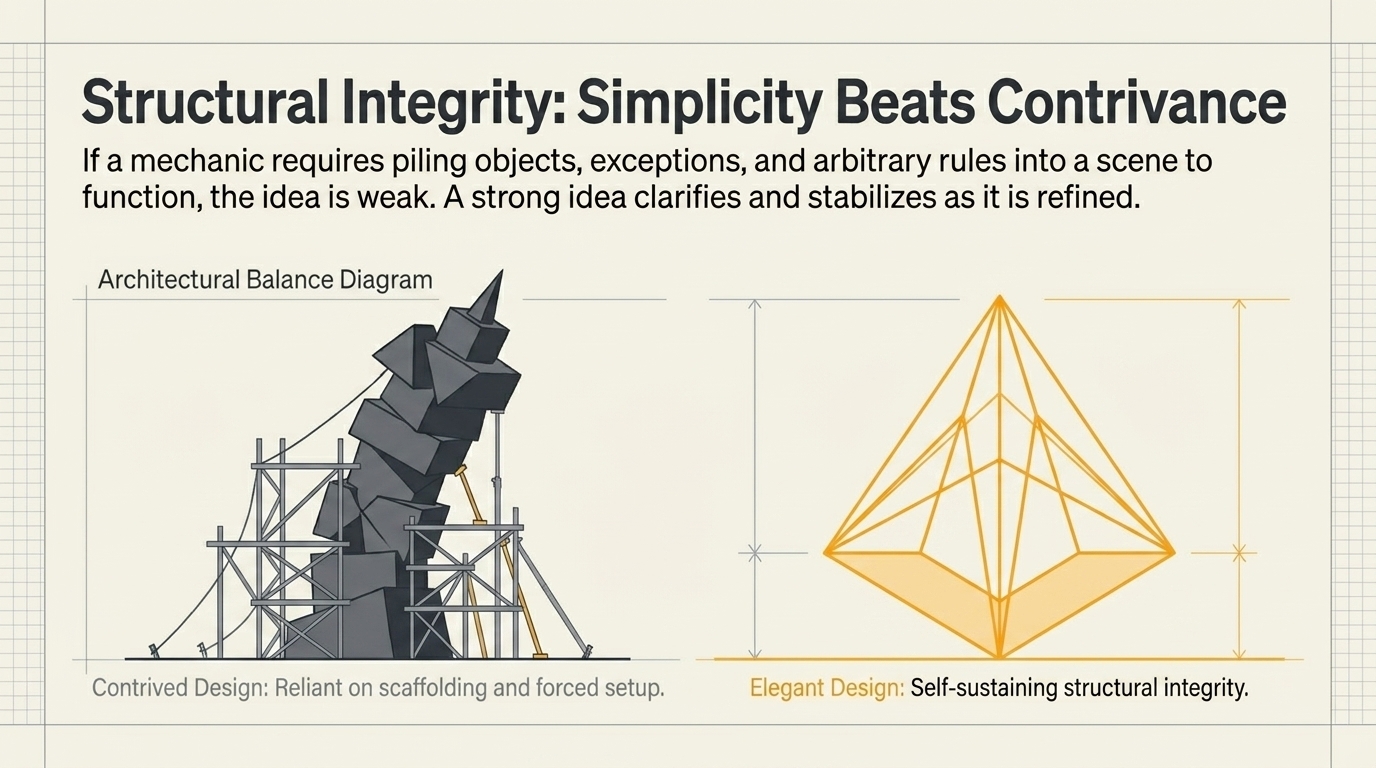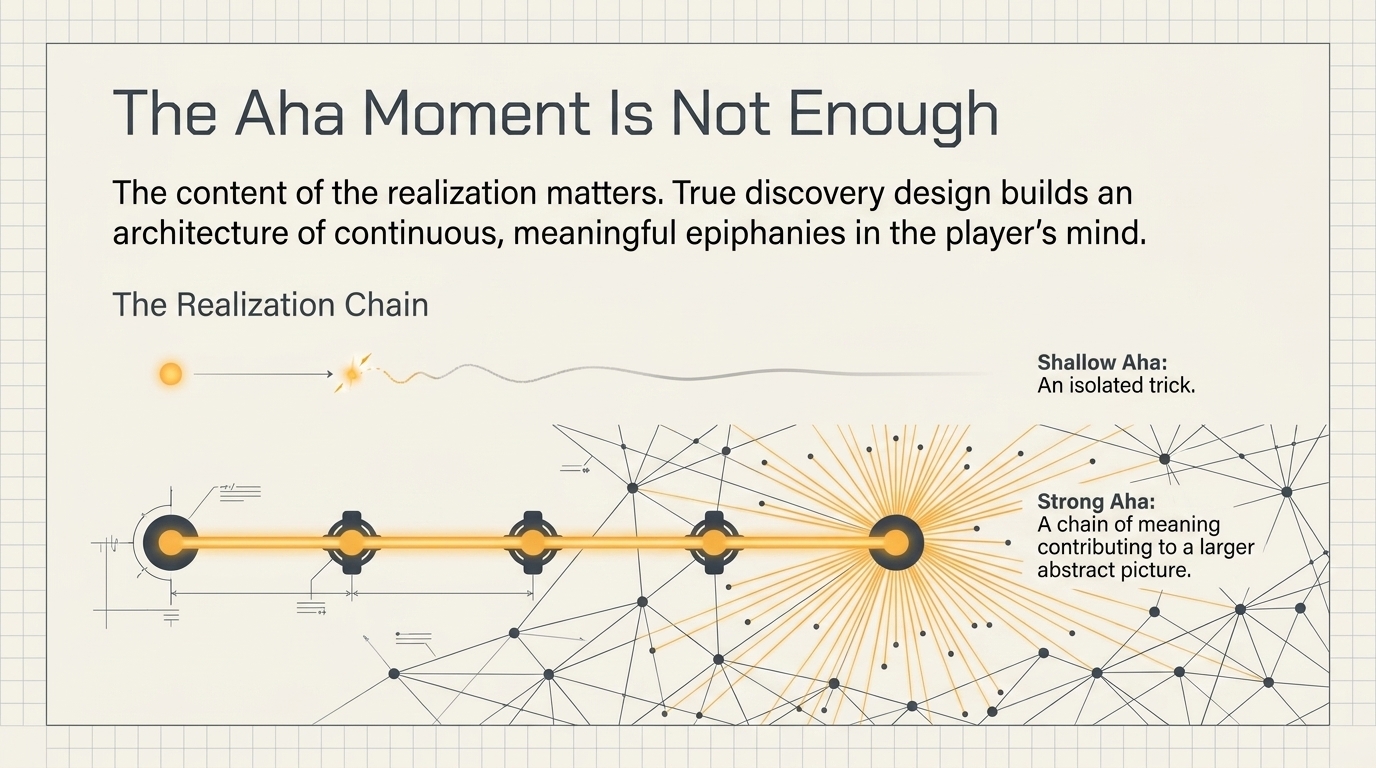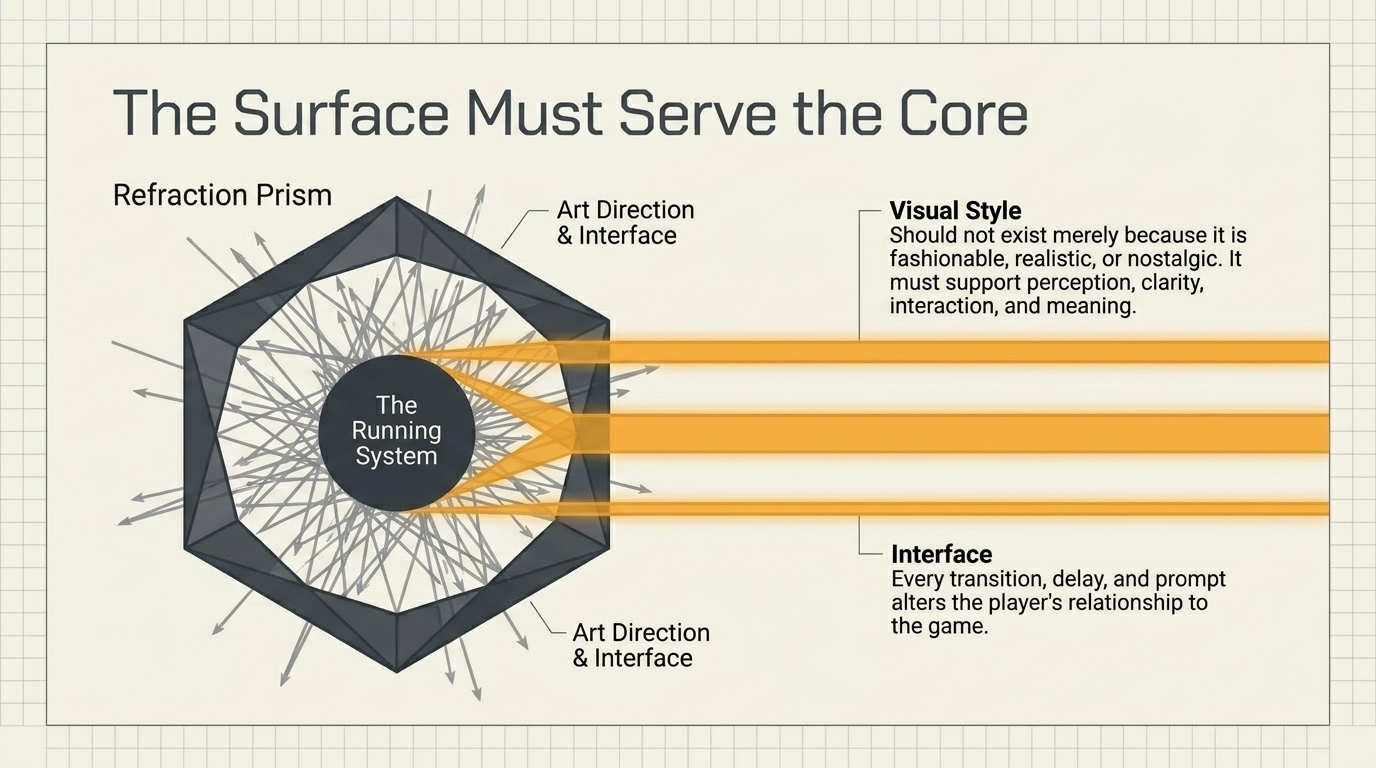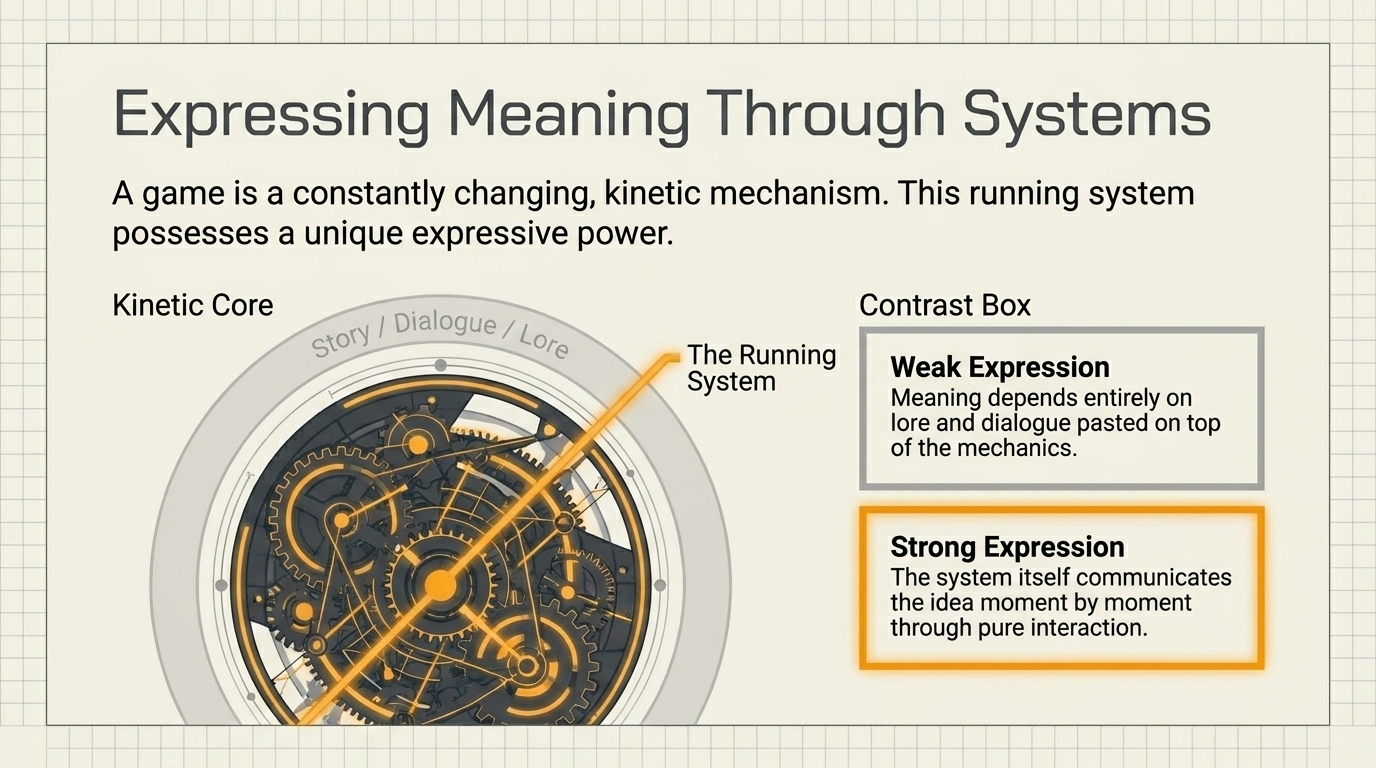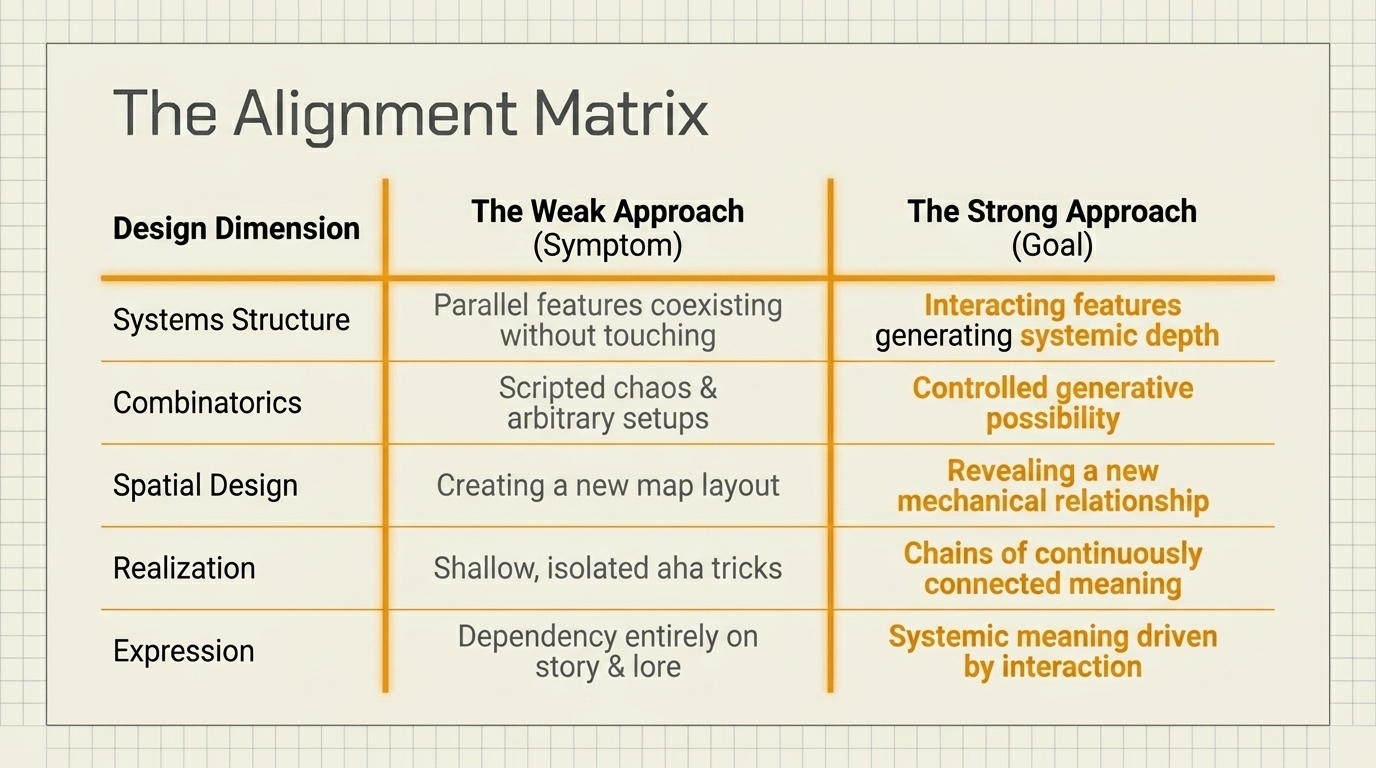
A game can contain many good ideas and still feel weak.
The mechanics may work.
The levels may be attractive.
The interface may be polished.
The story may be interesting.
Every feature may be defensible when considered alone.
But when the player touches the whole game, the experience feels divided. One feature asks for speed while another asks for patience. One system rewards experimentation while another punishes it. The interface interrupts the same flow the mechanics are trying to create. The story describes values that the player never experiences through play.
Nothing is necessarily bad.
The parts simply point in different directions.
This is a problem of coherence.
Coherence is not repetition. It does not mean that every mechanic must behave in the same way, every level must have the same rhythm, or every visual element must share one obvious meaning.
Coherence is alignment around a concrete player experience.
It is the architecture that makes different parts feel as if they belong to the same game.
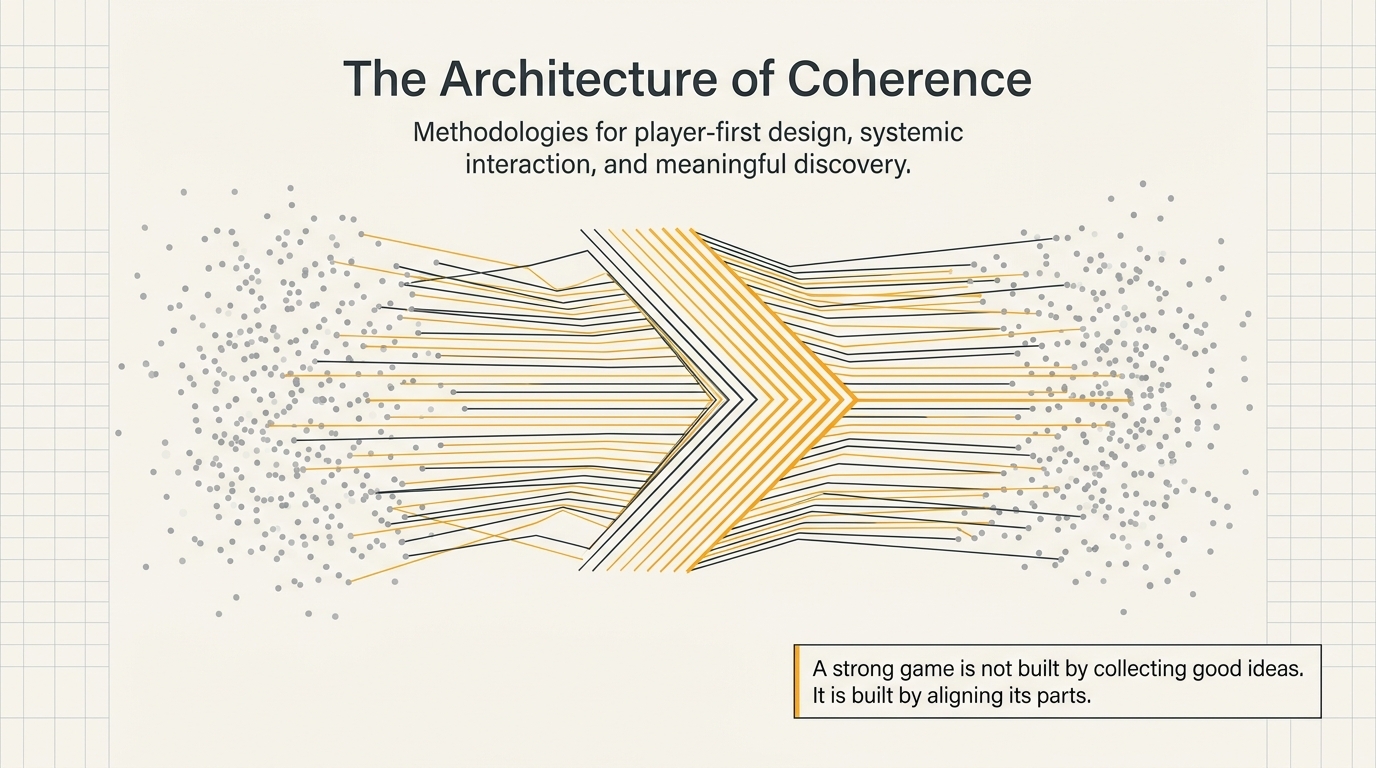
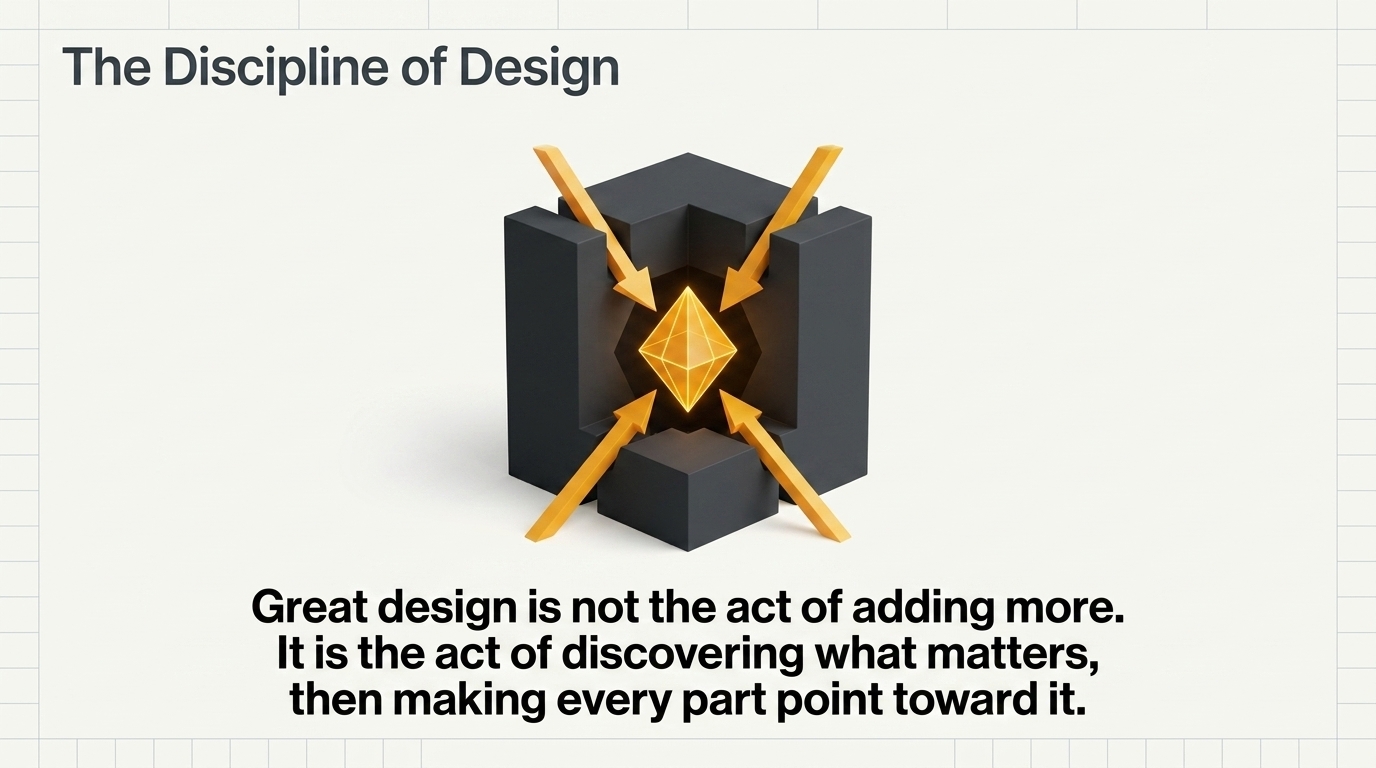
A strong game is not built by collecting good ideas. It is built by aligning its parts.
Good ideas can cancel each other out
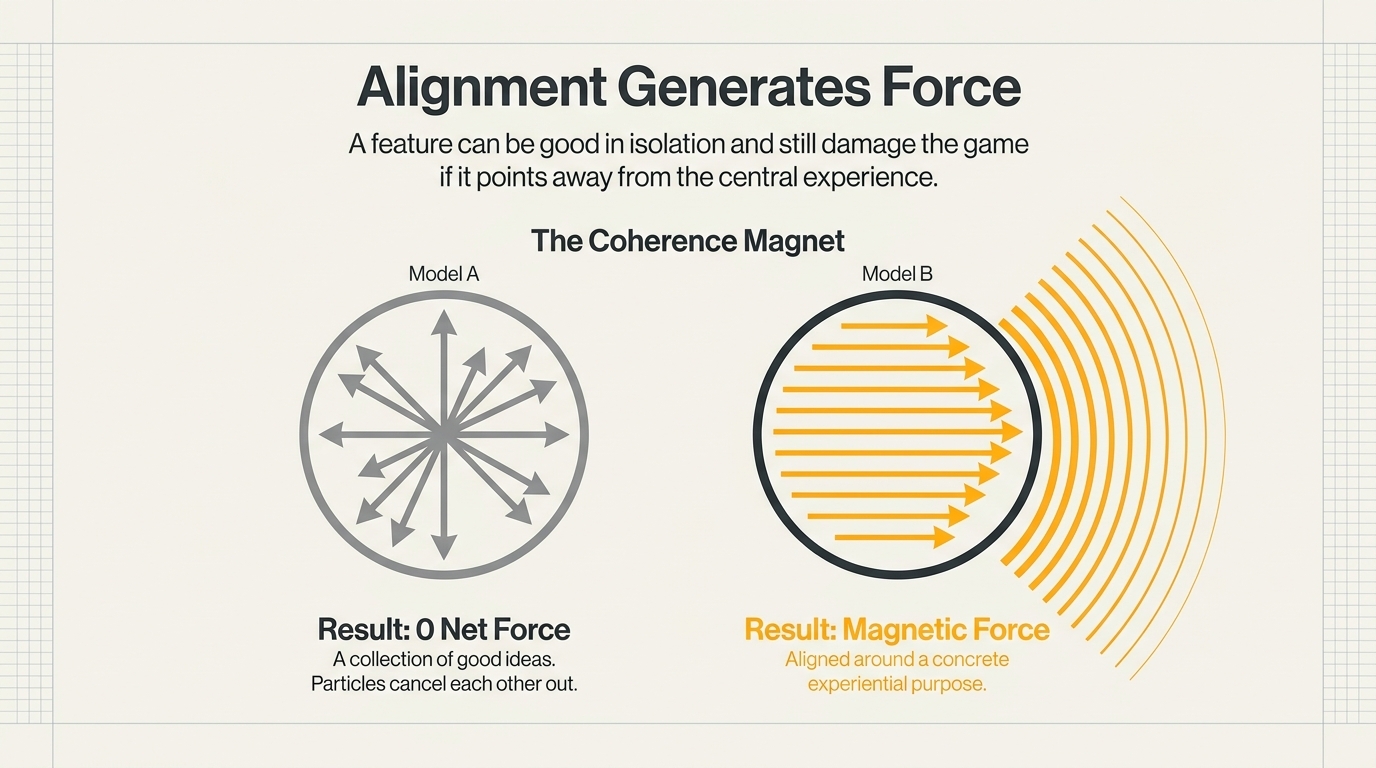
Jonathan Blow likes to imagine every design decision as a force, it is a clever way to see it.
A mechanic pushes the experience in one direction.
A level structure pushes in another.
The camera, interface, rewards, difficulty, sound, art direction, and narrative all apply force too.
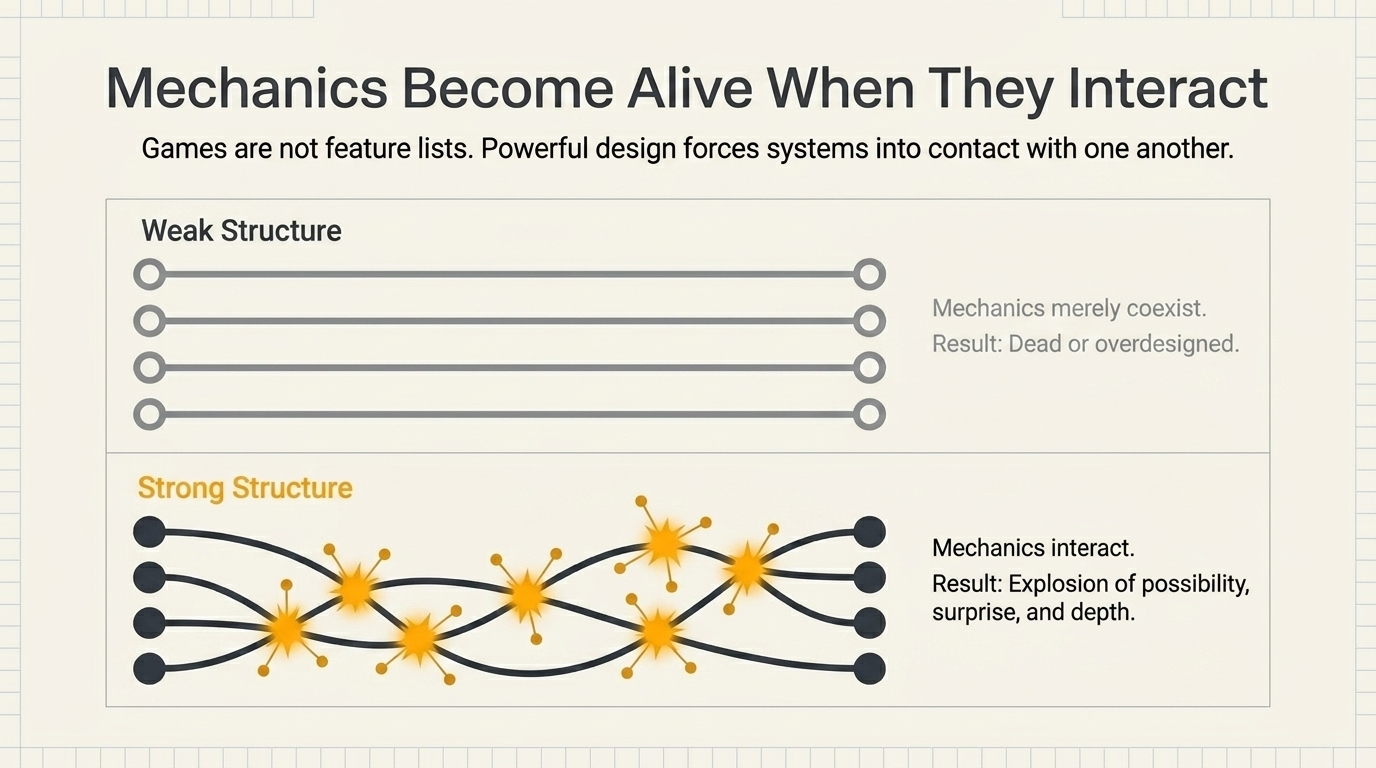
If these forces point everywhere, they begin to cancel one another. The game may contain a large amount of content, but the player receives very little net experience.
It becomes a collection of particles rather than a meaningful whole.
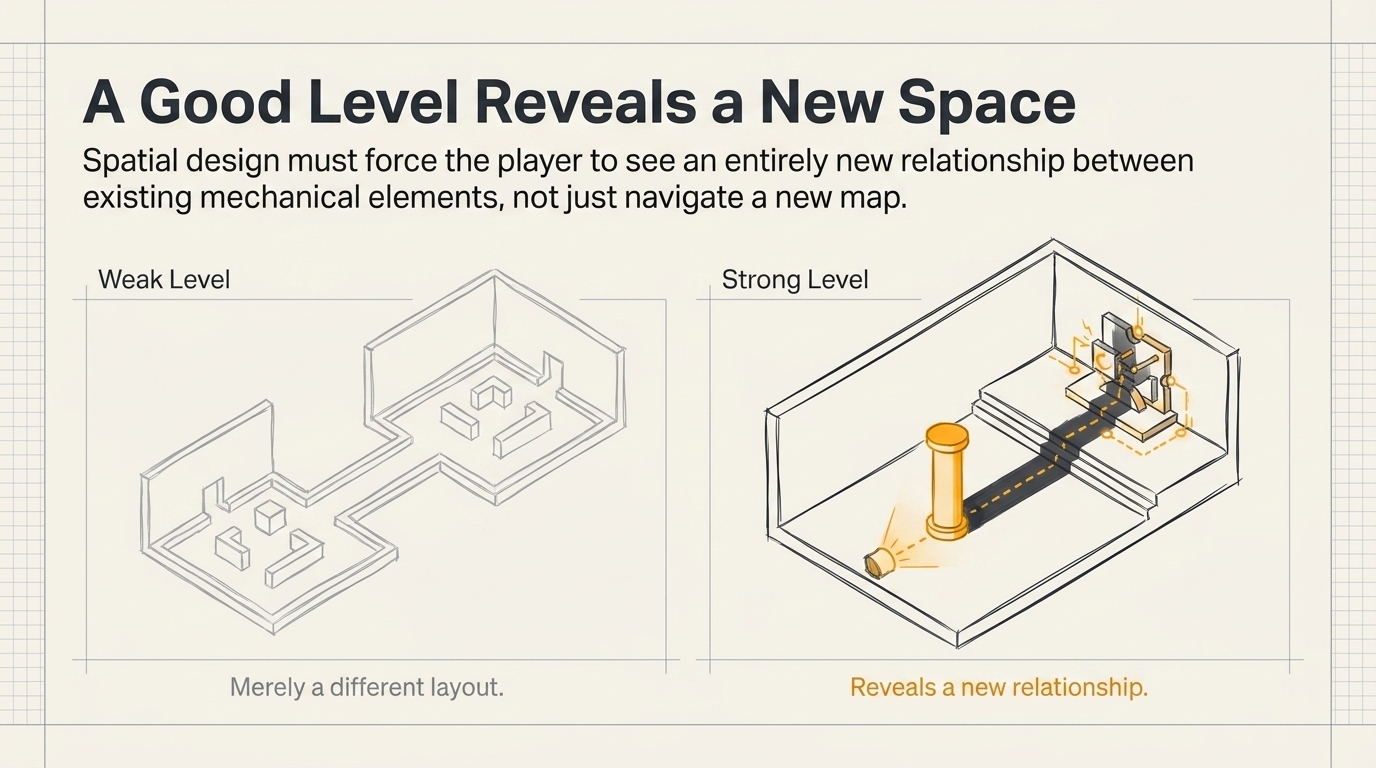
When those forces point toward a shared purpose, something different happens. The mechanic reinforces the level. The level gives the mechanic new meaning. The interface protects the player's attention. The art direction clarifies the interaction. The reward confirms what the game values.
The parts stop competing and begin multiplying one another.
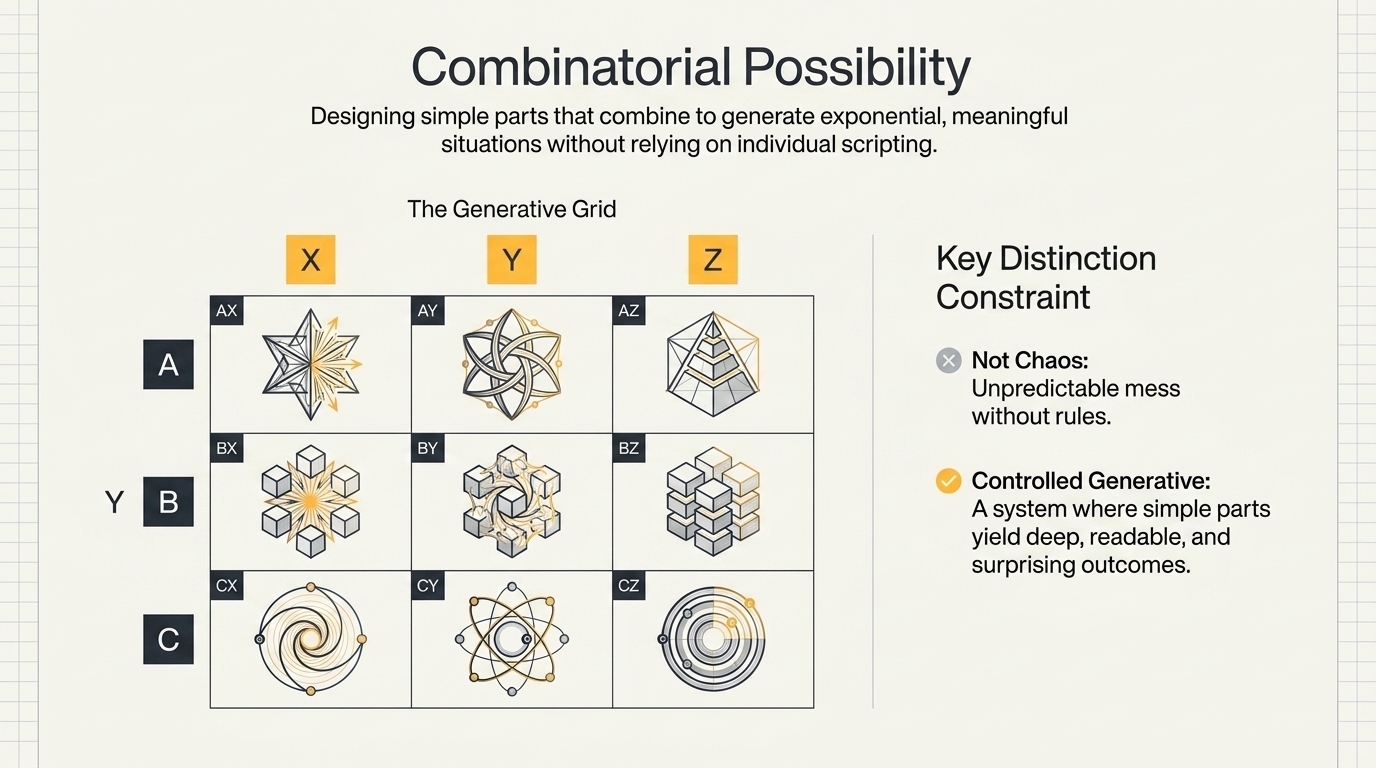
That is why a small coherent game can feel more powerful than a large game full of individually impressive features.
A feature can be good in isolation and still damage the game if it points away from the central experience.
The player experience is the first filter
When judging alignment, the first filter is not the feature list.
It is the player experience.
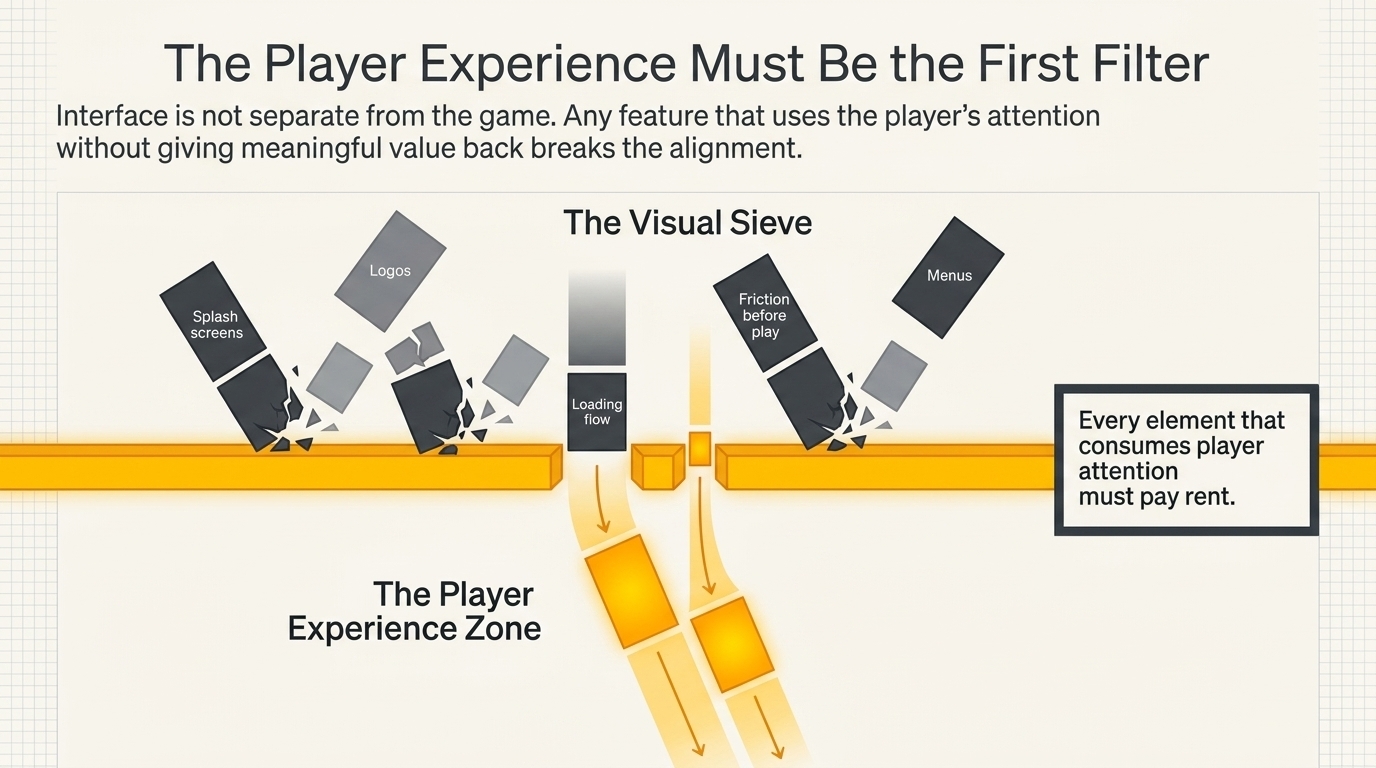
Every element that consumes the player's attention is part of the game. A menu is part of the experience. A loading transition is part of the experience. A camera delay, tutorial prompt, confirmation window, reward animation, and inventory interruption are all part of the experience.
Interface is not separate from gameplay simply because it appears on top of it.
Anything that changes the player's attention, timing, understanding, or intention changes the game.
Every element that consumes player attention must pay rent in meaning.
It must return something meaningful: clarity, anticipation, agency, rhythm, consequence, orientation, emotion, or useful information.
If an element repeatedly takes attention without returning value, it creates friction before play. Enough of these small interruptions can bury the experience even when the central mechanic is good.
(from Jonathan) When reviewing a feature, I ask:
- What does this ask the player to notice?
- What does it give back?
- Does it clarify the core experience or compete with it?
- Does it preserve the intended rhythm?
- Would the game lose meaning if this disappeared? These questions apply to systems, but also to every layer surrounding them.
The core must be concrete
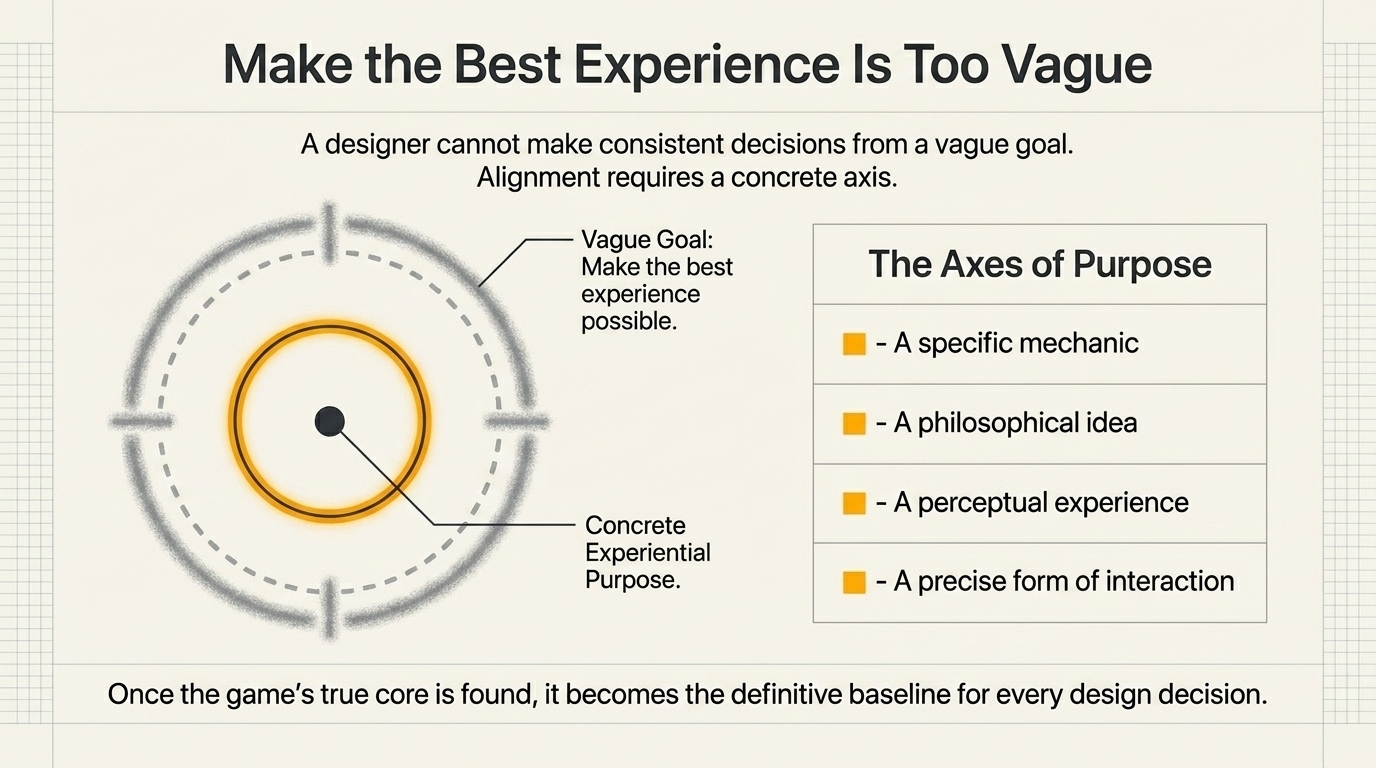
“Make the best experience possible” is not a useful design direction.
Everyone already wants to make the best experience possible.
The phrase cannot resolve disagreement because it provides no axis for a decision. One designer may believe that more freedom creates the best experience. Another may believe that strong authorship does. A third may believe that clarity matters more than surprise.
All three can claim to be improving the game.
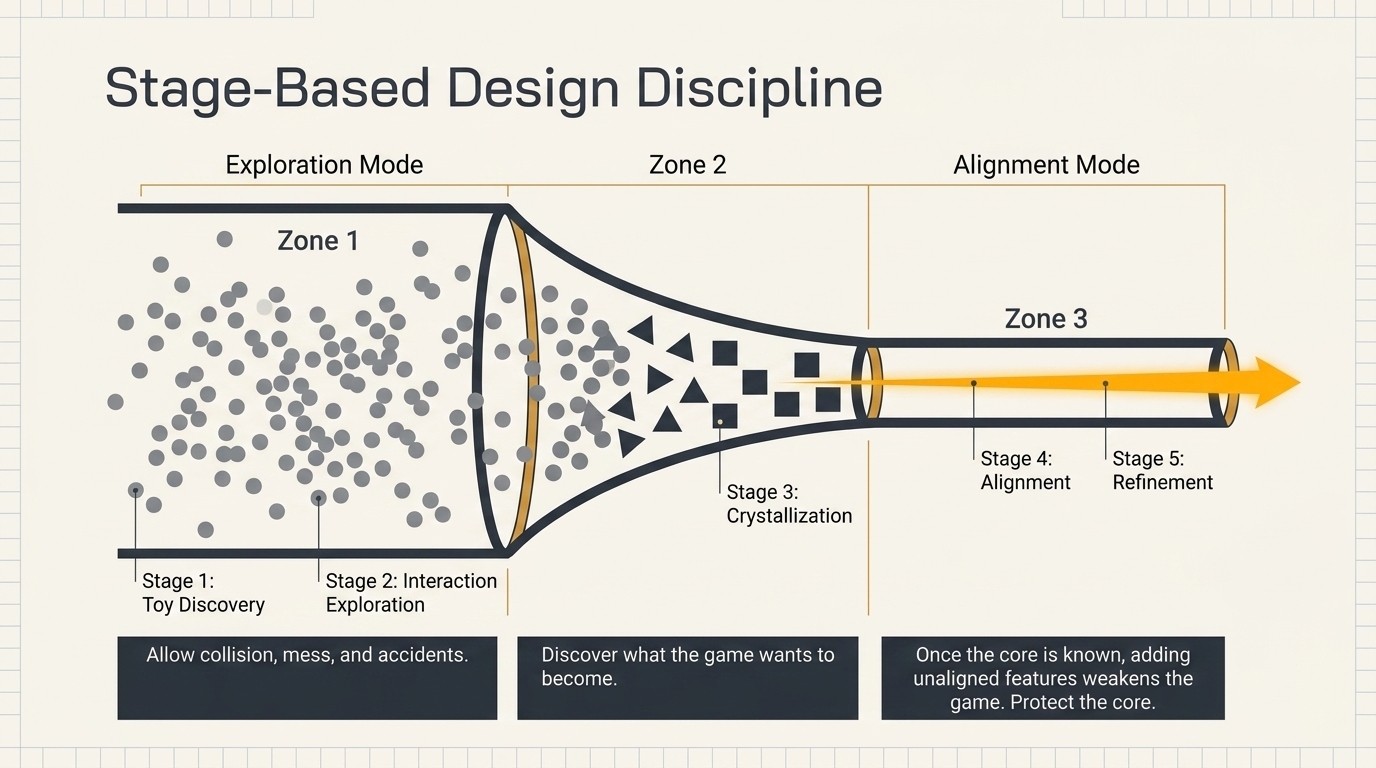
Alignment needs a concrete experiential purpose. I use to call it meaning
That purpose meaning may begin with:
- A specific mechanic.
- A philosophical idea.
- A perceptual experience.
- A precise form of interaction.
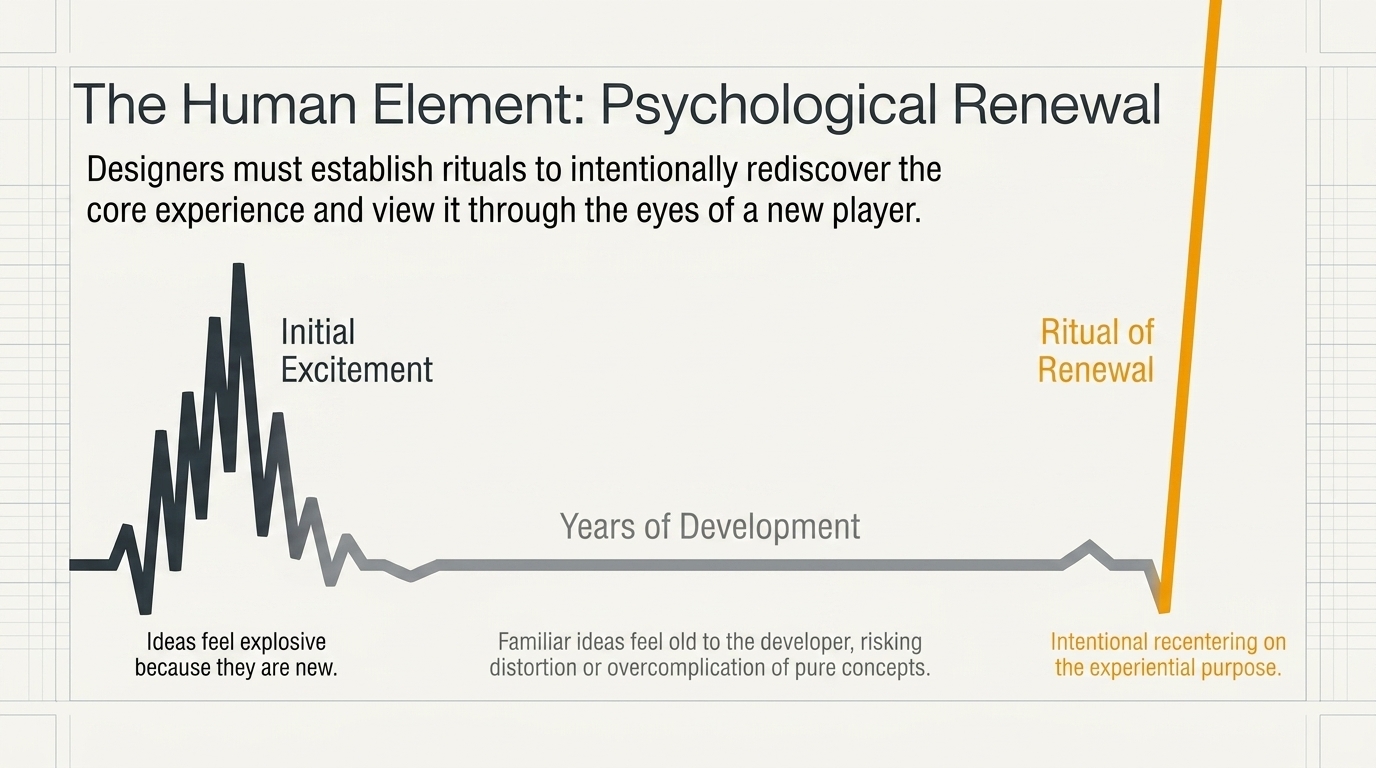
I asked NotebookLM to summarize it for me using slides, I hope it helps.